
How can muting strings help your guitar playing?
Sep 12, 2026When you’re first learning guitar, you sometimes mute strings by accident.
You put a fretting-hand finger on one string and accidentally touch another string so the sound doesn’t come out.
When that happens, you can curve your fretting-hand finger more to make sure it only touches the string you want to play.
But are there ways that muting strings can actually help your guitar playing?
Yes!
Here are three examples:
1. Variety in Strum Patterns
Let’s say you’re strumming like this:
D DU UDU
(D represents a down strum and U represents an up strum.)
If you want to make your strumming sound more interesting, you can occasionally add in a muted strum (represented by an X):
D DUXUDU
At the X, you will play a down strum with your picking hand while your fretting hand stops pressing down the notes and touches the strings lightly so only a muted sound is heard.
2. Easier Chord Switches
You can make chord switches easier by muting the last strum or two before a chord change.
Let’s say you're playing a G chord and then a C chord with this strum pattern:
G C
D DUD DUD DUD DU
If you’re struggling to switch chords cleanly between the up strum on G and the immediate down strum on C, you could mute the last two strums of G by lightly touching the strings with your fretting hand while you are readjusting them to the C chord:
G C
D DUD XXD DUD DU
This gives you more time to switch your fingers without creating a gap in sound.
3. Variety in Chord Shapes
You can create variety in chord shapes by muting a string within the chord.
For example, the standard G chord shape is played like this: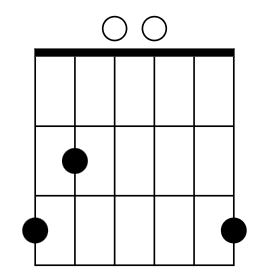
But you can create an altered G chord shape by muting the A string instead of putting a finger on it: 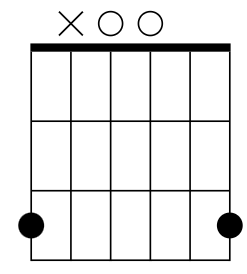
To do this, you let the fretting-hand finger on the big thick E string touch the A string and mute it.
By muting the A string, you make the chord easier because you can play it with two fingers instead of three.
And muting a string within a chord creates subtle variety in the way the chord sounds compared to the standard fingering.
So while there are definitely situations where you want to avoid muting strings, there are also situations where embracing muted strings can help your guitar playing.
Keep making music!
Struggling With Sloppy Chord Changes?
Get my free guide: 7 Steps to Play Smoother Chord Changes